Here's a scenario that trips up a lot of men on TRT. Your total testosterone comes back at a solid 800 ng/dL, your doctor says everything looks great, and you still feel flat, tired, and low on libido. What's going on?
The answer is nearly always the same. Total testosterone is only part of the story. The number that tracks how you actually feel is usually free testosterone, and the thing that controls free testosterone is a protein called SHBG. Once you see how these three numbers interact, a lot of confusing lab results start to make sense.
The three numbers that matter
Total testosterone is all the testosterone in your blood: every molecule, whether it's available to your tissues or not. It's the headline number, and it's the easiest to measure, which is why it's the one everybody quotes. If you're still getting your head around units, our guide on converting testosterone lab results between ng/dL and nmol/L is worth a read.
Most of your testosterone isn't free to do anything, though. It's bound to proteins:
- Roughly 40 to 50% is bound tightly to SHBG (sex hormone-binding globulin). This portion is locked up and biologically inactive.
- Roughly 50% is bound loosely to albumin. It releases easily, so it's mostly usable.
- Around 1 to 2% is completely free. Unbound and immediately available to your tissues.
Free testosterone is that unbound fraction. Bioavailable testosterone is the free portion plus the loosely-bound albumin portion, which is the total amount your body can actually use (Cleveland Clinic).
The takeaway: two men can have identical total testosterone and completely different amounts of usable testosterone, depending on how much is locked up by SHBG.
SHBG is the lever
SHBG (sex hormone-binding globulin) is a protein made by your liver that binds to testosterone and takes it out of circulation. The more SHBG you have, the more of your testosterone is bound and inactive, which means less free testosterone even if your total looks fine.
That's why SHBG matters so much on TRT:
- High SHBG means more testosterone bound and low free T, so you can have a great total number and still feel hypogonadal.
- Low SHBG means less binding and higher free T relative to total, so you might feel good at a lower total, or get symptoms of high free T even when your total looks moderate.
Things that push SHBG up: aging, thyroid problems (hyperthyroidism), liver conditions, some medications, and very low body fat.
Things that push SHBG down: insulin resistance, obesity, fatty liver, hypothyroidism, and, relevant here, testosterone itself. TRT tends to lower SHBG, which is part of why free T often rises more than you'd predict from the total (PubMed).
Why a "normal" total can be misleading
Say your total testosterone is 700 ng/dL. Sounds healthy. But the picture depends entirely on your SHBG.
If your SHBG is high, say 60 nmol/L, a large chunk of that 700 is bound and inactive. Your free T could be low, and you'd feel it. If your SHBG is low, say 15 nmol/L, much more of that 700 is available. Your free T could be near the top of the range, and you might even get symptoms of too much: irritability, acne, water retention.
Same total, two completely different experiences. This is the single biggest reason men chase their total number higher and higher while never feeling right. They're optimising the wrong figure.
What to actually measure
If you only ever look at total testosterone, you're flying half-blind. A useful panel includes:
| Test | Why it matters |
|---|---|
| Total testosterone | The baseline number, but not the whole picture |
| Free testosterone | Tracks symptoms more closely than total |
| SHBG | Explains why your free T is where it is |
| Albumin | Needed to calculate bioavailable T accurately |
| Estradiol (E2) | Rises with testosterone; part of the balance |
A quick note on measurement. The gold standard for free testosterone is equilibrium dialysis, but it's expensive and not always available. Many labs use a calculated free testosterone instead, derived from total T, SHBG, and albumin. That calculation is good enough to be genuinely useful, which is another reason to always get SHBG and albumin drawn alongside your total. The commonly-quoted "direct free T" immunoassay is the least reliable of the options, so don't lean too hard on it. All of this fits into a broader TRT blood work schedule.
Feeling flat despite a good total? Read your SHBG
If your total looks fine but you feel under-treated, high SHBG is the usual suspect. A few practical angles:
Injection frequency. More frequent, smaller injections keep levels steadier and can shift the free-to-total balance in your favour compared with big weekly peaks. Our protocol optimisation guide covers how to dial this in.
Address the metabolic side. SHBG is tightly linked to insulin sensitivity. Losing visceral fat and improving insulin resistance can move it, often in the direction you want. The habits in our lifestyle guide feed straight into this.
Don't just crank the dose. If high SHBG is binding everything, pushing total testosterone higher partly gets eaten by yet more binding. It's often smarter to work on frequency and metabolic health than to chase the total upward.
And if your SHBG is very low, the opposite applies. You may feel great and get symptoms at a lower total than you'd expect, so watch free T closely and resist the urge to dose by the total number alone.
Track all three together
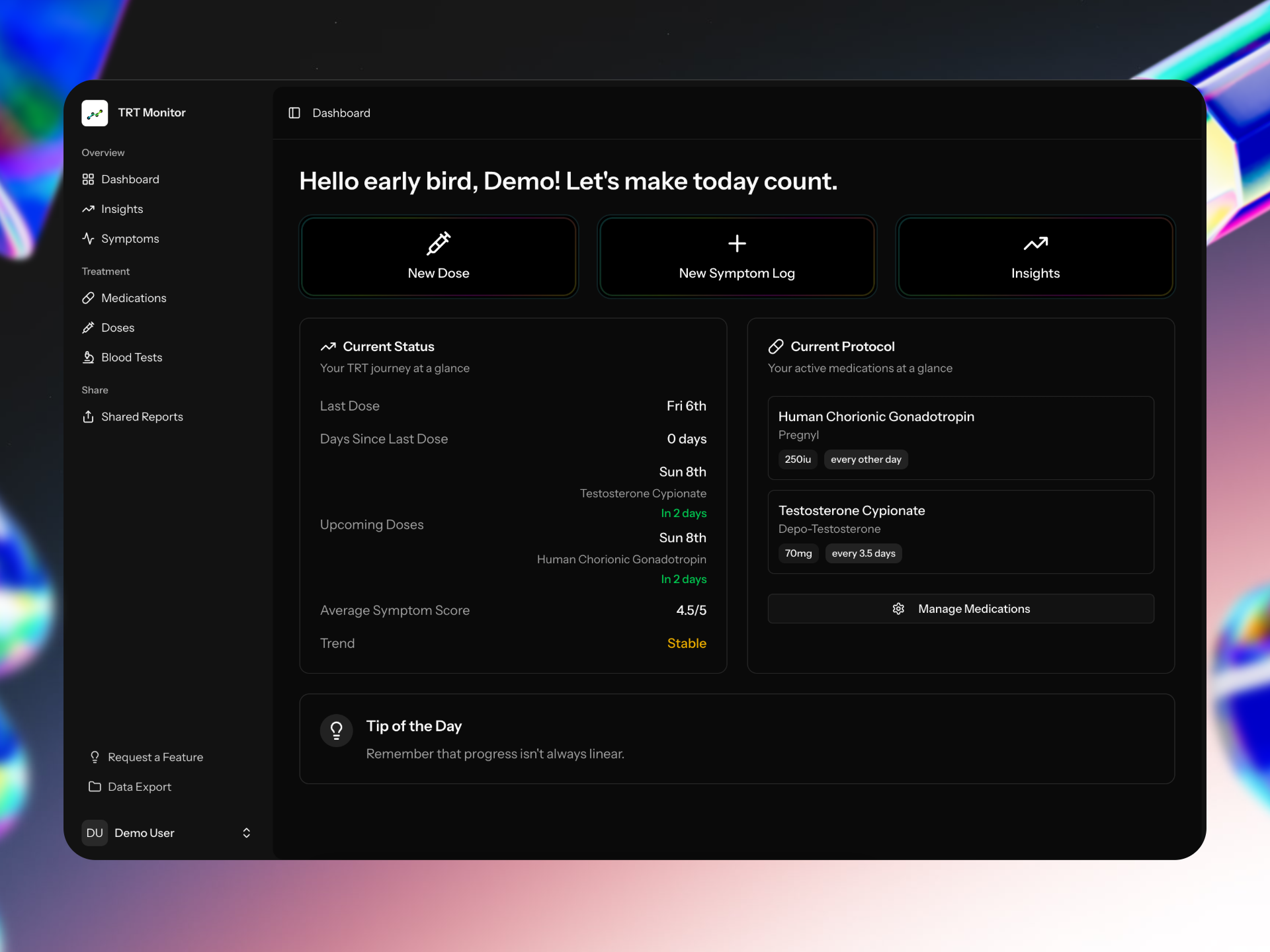
A single lab result is a snapshot. What actually tells you something is watching total, free, and SHBG move together over time as you adjust your protocol. That's what TRT Monitor is built for. Log each panel and you can see the relationships plotted out instead of buried in a stack of PDFs.
When you can see that bumping your injection frequency in one month lifted free testosterone without changing your total, or that improving your diet nudged SHBG in the right direction, you stop guessing and start making decisions from data.
The bottom line
Total testosterone is the number everyone quotes, but free testosterone is usually the one that tracks how you feel, and SHBG is the lever that connects the two. Get all three (plus albumin and estradiol) on your panel, judge your protocol by symptoms and free T rather than the headline total, and log the trend so you can see what's actually working.
Just getting started? Our beginner's guide to TRT and what to know before starting TRT cover the fundamentals first.